

In a reality a chemistry degree is just for teaching or lab work?
you spent almost 4 to 6 years of your life by remembering chemical equations, reaction mechanisms, computing titration curves, and getting through chemical lab at 8 A.M. what happens next? if your answer is become a science teacher and lab technician, you might be leaving a 6 figures salary on the table without even realizing it.
A chemistry degree is among the most profound qualifications you can hold. Chemists comprehend the fundamental principles of the universe, including energy, matter, and their transformations. Chemistry is not only a science but also the central foundation underpinning all health, natural, and applied science disciplines. The field serves many sectors, from life and environmental sciences to medicine, forensics, and perfume-making.
However, every year, thousands of chemistry graduates pursue the same five career options, while dozens of profitable, intriguing, and highly rewarding options remain unexplored. This guide is your blueprint to those alternatives with real-world salary figures and genuine advice on how to get there.
The Careers in chemistry Everyone Knows and Why They Might Not Be Enough
Let’s acknowledge the classics first. Most chemistry graduates are told about careers such as research chemist, lab analyst, quality control officer, or high school science teacher. These are honorable and meaningful careers. But if salary progression, location flexibility, or cross-disciplinary are matters to you, then the standard path has substantial limitations.
In the early career stage, a bench research chemist earns between $50,000 to $70,000 at a mid-sized pharmaceutical firm in the US. It typically has slow growth unless a researcher pursues a Ph.D. degree or transfers into management. That’s a turn into a totally different story from what’s achievable if chemists apply their chemistry knowledge in other fields such as finance, law, and regulatory affairs.
An example from a person who graduated with a 3.6 GPA in chemistry and is ready to spend his career behind a fume hood. One day, he met a patent attorney and had a conversation with him, and changed everything. After five years, he was earning twice as much as his colleagues. It was quoted in a C & EN article chemist who became a patent attorney.
Highest Paying Chemistry Career You’ve Probably Never considered
Chemistry graduates have a wide range of job options, including regulatory affairs, in addition to basic chemistry disciplines such as lab assistant, quality control, senior science teacher, and quality analyst. So, if you graduated in chemistry, don’t worry, you have a good future.
Patent Attorney or Patent Agent after chemistry graduation
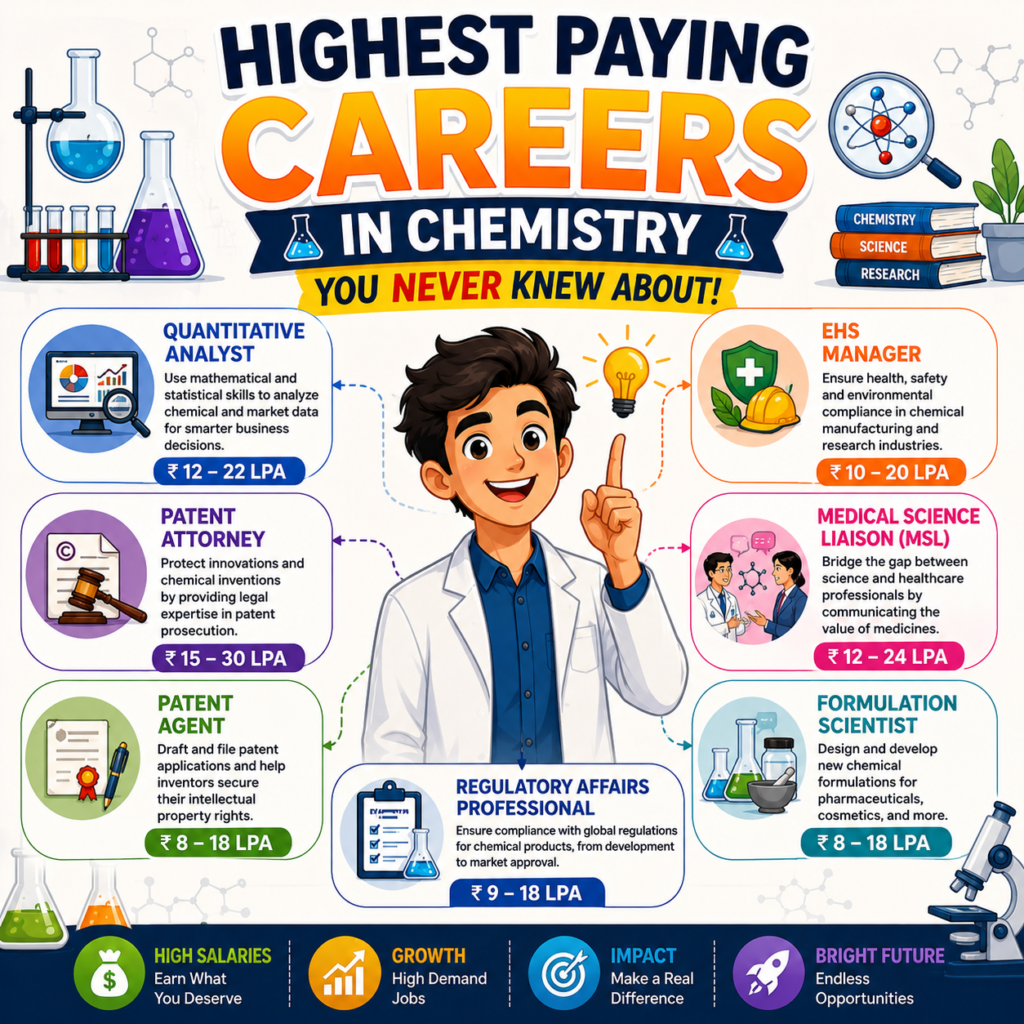
A career as a patent agent or patent attorney is ideal for those who value concise communication, logical thinking, and are intrigued by how inventions are protected. Patent attorneys and patent agents with backgrounds in chemistry are in demand, particularly in materials science, pharmaceuticals, and biotechnology. If you hold an undergraduate degree in chemistry, you may take the USPTO patent bar exam to become a patent agent. With a law degree, you may qualify as a patent attorney. Both roles offer a competitive salary.
Imagine waking up, reviewing a new drug compound proposal from a pharmaceutical customer, and then spending your day writing claims that will protect their novel idea for the upcoming 20 years. like how you become a link between business and science, and both parties need you desperately.
Salary Range:
Patent Agent: $90,000 – $140,000
Patent Attorney: $180,000 – $350,000+
Quantitative Analyst in finance
Wall Street no longer primarily seeks math PhDs. Instead, chemistry graduates especially those trained in computational modelling, statistical thermodynamics, and physical chemistry are securing highly paid quantitative analyst positions at investment banks, fintech’s, and hedge funds. Why this preference for chemistry? Because successful quants must model complex systems with many variables, manage ambiguous data, and think probabilistically—skills that are core to physical chemists’ daily work.
These career positions are not exclusively reserved for males; women are also performing them exceptionally well. A woman who used to work as a computational chemist, developing models to forecast commodity price fluctuations using refinery output data. Now, her molecular dynamics modelling skills are being applied to the development of algorithmic trading strategies.
Salary Range:
Entry-level Quantitative analyst: $120,000 – $160,000 (plus significant bonuses)
Senior Quantitative analyst: $250,000 – $500,000+
Regulatory Affairs Specialist in Pharmaceutical and Biotech
Every cosmetic, food additive, medicine, drug, and medical device that enters the market for public use must navigate a labyrinth of government rules and regulations. Regular affairs professionals are the people who make it happen according to strict requirements and do it correctly, for which corporations pay them a premium salary.
For these types of positions, your chemistry degree is the edge for you because you understand the science behind product formation. If you have a chemistry degree and understand EMA, FDA, and ICH guidelines, you will be in great demand. Many regulatory professionals never step foot on a lab bench again; instead, they attend meetings, write strategies, and submit documents with legal and medical terms.
Salary Range:
Regulatory Affairs Specialist: $75,000 – $120,000
Senior / Director level: $140,000 – $220,000
Formulation Scientist in Personal Care & Cosmetics
The worldwide cosmetics industry, worth over $500 billion, relies on chemistry. Formulation scientists develop scrubs, personal hygiene products, shampoos, sunscreens, moisturizers, and cosmetics while meeting safety, stability, aesthetics, and regulatory standards.
This is a profession in chemistry that combines creativity and science. You are making different things, not only following procedures, but you are also the inventor of those things that others use every day. Many famous brands, such as Estée Lauder, L’Oréal, and Unilever, have dedicated R &D departments staffed by chemists, although independent cosmetic brands offer a market for freelance formulation.
If a person is demotivated by his chemistry degree and believes he has no future, picture a chemist working at a skincare firm who spent Monday analyzing the pH stability of vitamin C serum and another day evaluating packaging compatibility data. On Friday, he will be meeting with the marketing team to explain how this product is best in use, is completely water-free, and the solution is not shelf-stable for life. Then, every week, business and science come together again.
Salary Range:
Formulation Scientist: $65,000 – $110,000
Senior Formulator / R&D Director: $120,000 – $175,000
Environmental Health & Safety Manager
Environmental health science managers work to bridge the gap between research and policy through chemical companies, energy, and manufacturing products. As global climate regulations are tightened, corporations desperately need chemists and others who have chemical knowledge to thoroughly analyze environmental risks and articulate them in regulatory language.
This profession is experiencing faster growth than any other chemistry-related field. The Environmental Protection Agency (EPA) and its international counterparts are expanding their regulatory supervision, and companies are facing increasing penalties for noncompliance. A chemistry graduate who is competent to enter a facility, evaluate chemical hazards, and develop mitigation protocols is worth several times their salary.
Salary Range:
EHS Specialist: $70,000 – $100,000
EHS Manager / Director: $120,000 – $180,000
Medical Science Liaison (MSL) profession
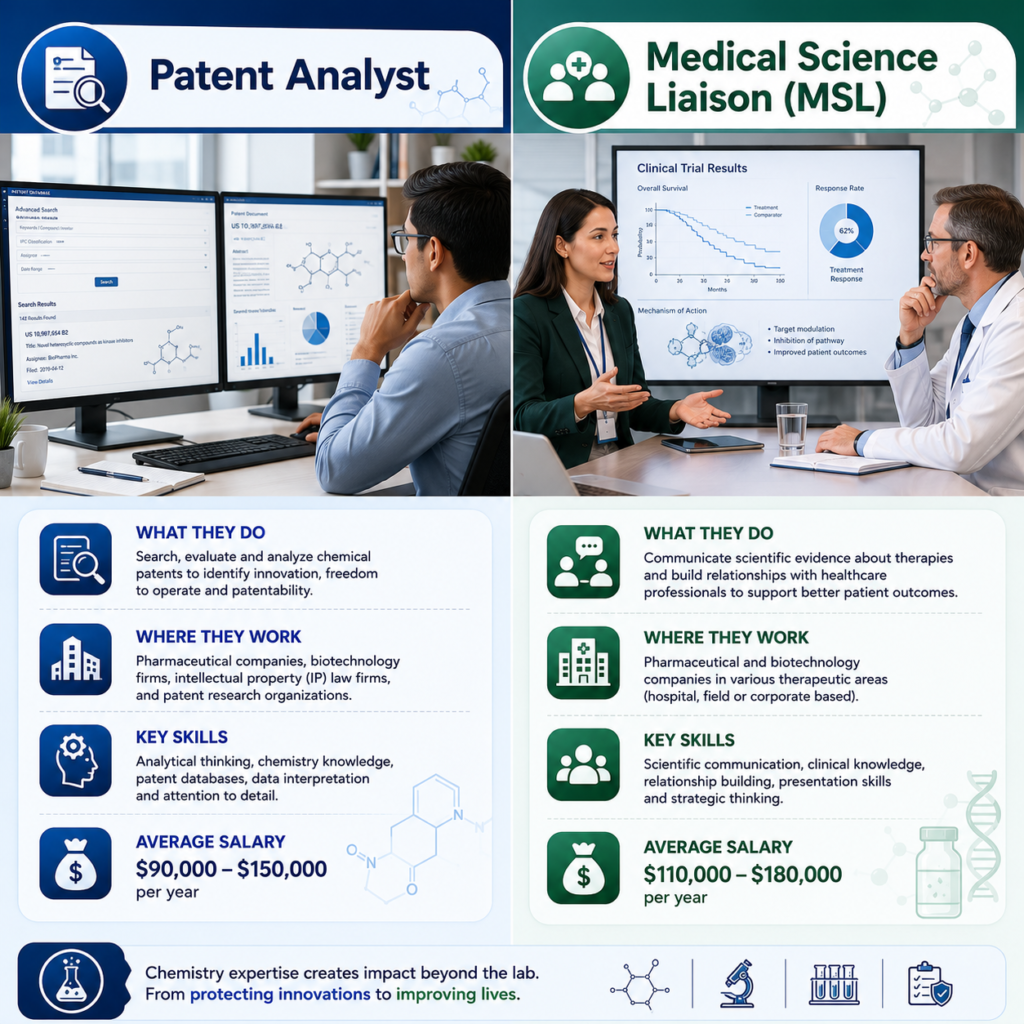
Medical Science Liaisons work at the intersection of science, medicine, and business. They work for pharmaceutical corporations as scientific experts, educating KOLs (Key Opinion Leaders), physicians, and healthcare professionals about novel drugs and therapies.
Unlike sales reps, MSLs educate others rather than sell. Their profession requires deep scientific knowledge, such as a chemistry degree that qualifies, excellent communication skills, and the ability to interpret complex data into understandable clinical conversations. An advanced degree in education is beneficial; however, many MSLs enter with a strong BSc or MSc background.
Salary Range
MSL (entry/mid): $110,000 – $150,000
Senior MSL / Regional Director: $160,000 – $220,000
Quick Comparison of the Highest Paying Chemistry Careers
| Career | Qualification | Avg. Salary in (US) Convert into your own currency | Growth Outlook |
| Quantitative Analyst | BS CHEMISTRY + programming skills | $120K – $500K+ | ⬆ Very Strong |
| Patent Attorney | BS Chemistry + JD | $180K – $350K+ | ⬆ Very Strong |
| Patent Agent | BS Chemistry + USPTO Exam | $90K – $140K | ⬆ Strong |
| EHS Manager | BS Chemistry + certifications | $70K – $180K | ⬆ Strong |
| Medical Science Liaison | Bs chemistry + Msc | $110K – $220K | ⬆ Very Strong |
| Formulation Scientist | BSc Chemistry | $65K – $175K | ➡ Moderate |
| Regulatory Affairs | BSc Chemistry | $75K – $220K | ⬆ Strong |
How to make transition from lab to high paying career jobs in chemistry
The most common question every chemistry graduate ask is I have no experience in finance, law, affairs, or regulatory matters.” How do I get in?
The truth is that your degree in chemistry is a competitive advantage for you, not a constraint. There is no need for concern about the skills gap in the scientific sector, rather than in the business or legal sectors. Additionally, you are in science and are already ahead.
Practical guide/steps to change your chemistry profession
Patent Agent
With a chemistry degree, you need to prepare for the USPTO patent bar exam. For preparation, you can use Pat Bar and Wyse Bridge, which offer excellent preparation courses.
Finance/Quant
They value a person with a chemistry background more than one with a pure finance background. You need Python or R skills to pass the CFA Level 1 exam. After that, apply to fintech firms and energy trading companies.
Regulatory Affairs
During BS Chemistry, you need to complete the Regulatory Affairs Professionals Society (RAPS) certification. Almost all the pharmaceutical firms offer entry-level RA roles to BSc chemists.
MSL Route
Develop your clinical communication skills while building a network on LinkedIn. Gain 2–3 years of research experience. Building a network is an edge because for these types of jobs, referrals are required most of the time.
Unconventional Chemistry Careers Worth Knowing
Flavour Chemist
A flavor chemist, or flavorist, is a scientific specialist who employs sensory skills and chemistry to develop, analyze, and refine natural and artificial flavors for consumer products, beverages, and food. They develop new flavors, aromas, or tastes to enhance the appeal of their products. They have mostly earned $75K – $120K. For this profession, they are required to have a bachelor’s degree in chemistry and food science, as well as a demanding seven-year training program.
Forensic Chemist
A forensic chemist examines explosives and unknown compounds, fire trash, illegal drugs, and non-biological trace evidence discovered at crime scenes to assist criminal investigation teams. They use complex scientific equipment, such as mass spectrometry and gas chromatography, to identify unknown and known items, reconstruct events, and provide legal and expert testimony to law enforcement authorities or private forensic laboratories. They have mostly earned $65K – $110K They mostly collaborate with forensic agencies, the DEA, and AFT agencies. For this profession, they must have a bachelor’s degree in chemistry and specialized training in forensic toxicology.
Battery / Energy Materials Scientist
A Battery/Energy Materials Scientist studies, develops, and tests new materials to increase battery performance, energy density, safety, and cycle life, with a focus on lithium-ion, solid-state, and next-generation technologies. They frequently work in laboratories conducting experiments and synthesizing materials such as anodes, cathodes, and electrolytes. They are also testing synthetic materials using advanced characterization technologies, such as electron microscopy. For this profession, they typically require a Master’s or PhD in Chemistry, Chemical engineering and Materials Science. With these degrees, they also prefer a person who has strong data analysis skills to interpret structural and electrochemical characterization data. A Battery/Energy Materials Scientist earns about $ 80k – $ 180k.
Green Chemistry Consultant
Green Chemistry consultants are professional scientists who assist firms in developing and designing more sustainable chemical products and implementing environmentally friendly manufacturing techniques. They are working to connect industrial practices with environmental rules by focusing on renewable resource utilization, hazardous waste reduction, increasing product efficiency and safety, and bridging the gap between industrial innovation and sustainability goals.
The real secret of chemistry degree careers Chemistry is not a destination, but a launchpad.
The most powerful insight for anyone with a chemistry degree is that your degree shapes how you think. It is not just a job title. You can explain technical ideas to people without a technical background. You also understand complex systems. Even when things are uncertain, you can do precise work.
A chemist who understands their own adaptability will earn a place of respect and responsibility in the workplace. You have many valuable skills from hedge funds to control the agencies, and your ability to work in law firms is not dependent on your knowledge of the periodic table.
Your career in chemistry that you build does not have to resemble what your professors described. It can look like anything you design it to be, as long as you are willing to think outside the lab.
Important notes:
Share this career guide with fresh graduates, your fellows, and anyone looking for chemistry careers. Drop a comment in the section below and tell us about the career in chemistry you wish someone had told you about earlier. Subscribe to this site for more career insights.
Which Careers Can I Pursue With a Chemistry Degree?
You can purse many careers that give you constant growth in your careers like you can become a quality control chemist, Medicinal chemist, Materials scientist as well as research director as well as you have a chance to work as a r & d specialist.
Which Career Is Best for Women with a Chemistry Degree?
From research and industry to entrepreneurship, women are making significant contributions across every field of chemistry. High-demand career options include Research Scientist, Pharmaceutical Scientist, R&D Analyst, Analytical Chemist, Quality Control (QC) Chemist, Quality Assurance (QA) Specialist, Environmental Chemist, Forensic Scientist, Materials Scientist, and Regulatory Affairs Specialist.
What Is the Highest-Paying Job for Chemists?
The highest-paying jobs for chemists are typically found in industries such as biotechnology, pharmaceuticals, energy, and research management. However, how much you earn depends on several factors, including your level of education and the country you work in, years of work experience, and the industry you choose.

